Patient resources
Here caregivers and patients can find a regularly updated list of studies, therapies, educational support resources, and doctors helpful to FOXP1 individuals.
What you can do now
The FOUND Study—now enrolling
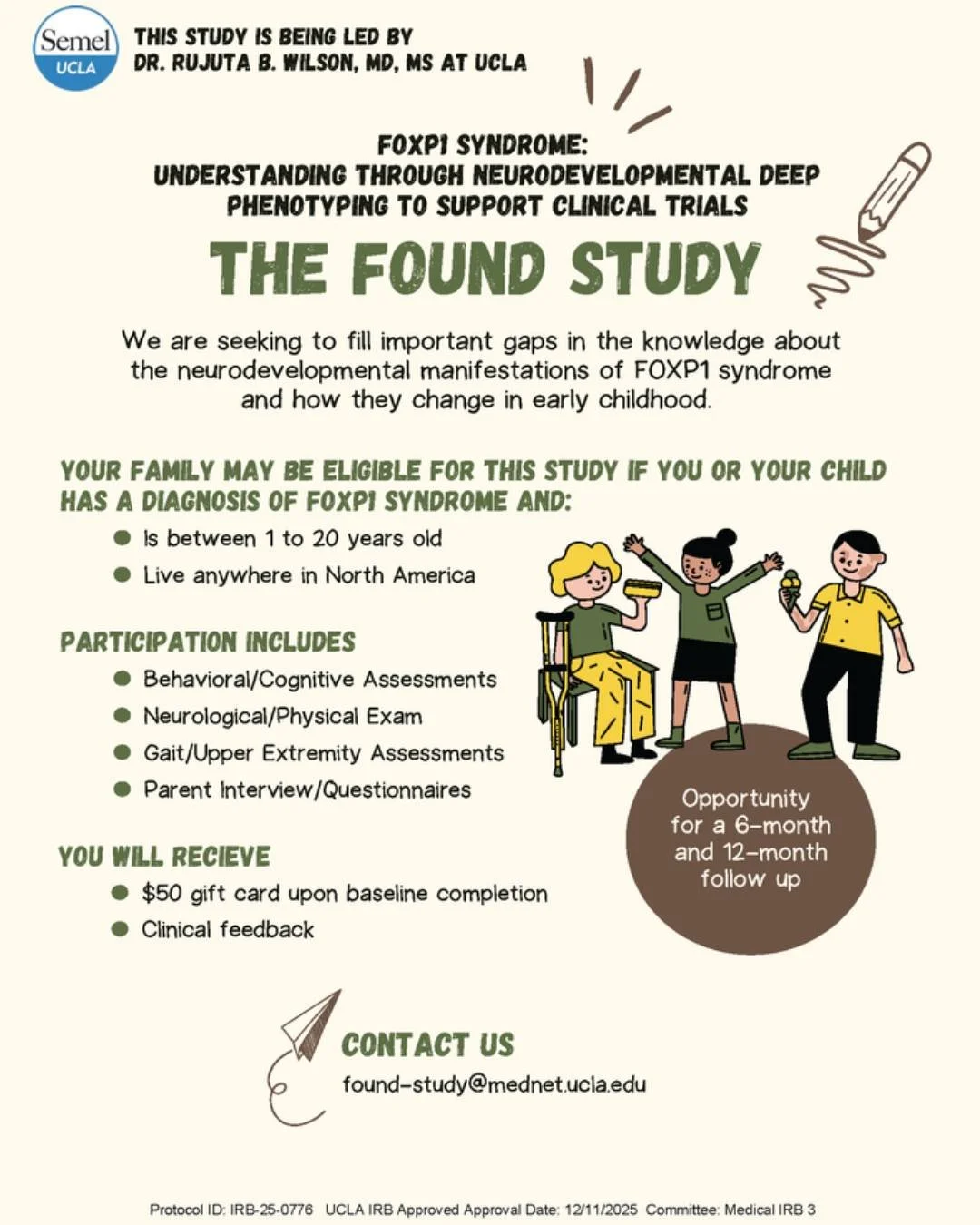
Dr. Rujuta B. Wilson, MD, at UCLA is leading the FOXP1 Syndrome: Understanding through Neurodevelopmental Deep Phenotyping to Support Clinical Trials (FOUND) Study—a longitudinal natural history study aimed at filling critical gaps in our understanding of the neurodevelopmental features of FOXP1 syndrome. To join the study or connect directly with the research team, please email found-study@mednet.ucla.edu and express your interest.
-
A natural history study helps us understand how individuals with FOXP1 syndrome develop and change over time. By carefully tracking symptoms and progression, the study creates a clear baseline of what the condition looks like without treatment—information that is essential for developing future therapies. This baseline gives regulators like the FDA a benchmark to determine whether a new treatment is truly making a meaningful difference for individuals with FOXP1 syndrome.
-
Families living in North America with a child between the ages of 1 and 20 who has a confirmed diagnosis of FOXP1 syndrome are eligible to enroll.
-
The study takes place over one year and includes three visits: a baseline evaluation, a six-month follow-up, and a twelve-month follow-up. Each visit includes motor, language, behavioral, cognitive, and autism symptom assessments, along with a parent interview covering your child's medical history, behavior, and development.
All participating families will receive written and verbal feedback on their child’s assessment results.
-
Assessments are conducted at UCLA in Los Angeles. Travel support is available to help families attend in-person. For families who are unable to travel, virtual participation is also available: study materials are mailed directly to you, and assessments are completed via videoconferencing.
-
Families will receive $50 for the baseline evaluation, $25 for the six-month follow-up, and $25 for the twelve-month follow-up, for a total of up to $100. All participating families will receive written and verbal feedback on their child's assessment results.
Citizen Health
Citizen Health was co-founded by Nasha Fitter—a FOXG1 syndrome mom and co-founder of the FOXG1 Research Foundation—so it was built by someone who truly understands the rare disease journey. The FOXP1 Medical Research Foundation and the International FOXP1 Foundation have partnered with Citizen Health to support our families and researchers.
Citizen Health collects records from all of your child’s providers in one secure place and gives you an AI Advocate that can answer your questions without digging through stacks of paperwork. Families have found it especially helpful for preparing for doctor appointments, managing insurance reimbursement, qualifying for services, and completing paperwork. In fact, FOXP1 families have already told us that Citizen Health made completing the FOUND Study surveys easier and faster.
Citizen Health is HIPAA-compliant, built specifically for rare disease families, and free to families. You can also choose to contribute anonymized data to help power future FOXP1 research.
RARE-X
RARE-X is a global data collection platform created by Global Genes to support rare disease research by enabling families to securely share information about their lived experiences. The FOXP1 Medical Research Foundation, the International FOXP1 Foundation, and several international FOXP1 organizations have partnered with RARE-X to help build a shared FOXP1 data resource.
While Citizen Health focuses on collecting and organizing medical records, RARE-X centers on parent-reported data—your firsthand observations about your child’s development, health, and daily life.
-
Participation in RARE-X is entirely remote and survey-based. Parents and caregivers complete online questionnaires describing their child’s medical history, development, behaviors, and quality-of-life experiences. No clinic visits are required, and there is no cost to participate. You can complete surveys at your own pace and return over time to update information as your child grows. Families retain control over their data and decide whether their de-identified information may be shared for research purposes.
With your consent, de-identified data may be made available to qualified researchers for research and analysis.
-
By participating in RARE-X, you help improve understanding of how FOXP1 syndrome presents and changes over time across individuals, support academic and nonprofit researchers studying the natural history of FOXP1 syndrome, identify patterns and areas of unmet need that can guide future research priorities, and ensure that the voices and experiences of FOXP1 families are represented in the research landscape.
RARE-X is an important tool for capturing real-world experiences that are often missing from traditional medical records.
Since there are currently no pharmaceutical treatments for FOXP1 syndrome, therapy is the first line treatment and can be very beneficial. All FOXP1 patients struggle with speech and language and many struggle with feeding, fine and gross motor, global developmental delay, and vision.
Each patient will have unique strengths and areas for improvement. Therapy needs should be determined on a case by case basis for each FOXP1 patient.
Therapy
Therapies to consider
Speech and feeding therapy
Occupational therapy
Physical therapy
Special instruction
Vision therapy
Behavioral therapy, such as ABA or ESDM
Hippotherapy
Physicians
The symptoms a FOXP1 patient might experience range widely. Different patients might need different specialists.
SPECIALISTS TO CONSIDER
Geneticist
Neurologist
Developmental Pediatrician
Psychiatrist/psychologist
Ophthalmologist
Immunologist
Cardiologist
Dermatologist
Nephrologist
Audiologist
Gastroenterologist
Physicians and clinicians experienced with FOXP1 syndrome
Most clinicians have no prior FOXP1-specific experience, and those who do typically have limited experience. Parents should be aware that even these more experienced clinicians are unlikely to recommend treatment different from standard care protocols described in the medical literature.
For families interested in a comprehensive evaluation, the FMRF recommends contacting the research team at UCLA to inquire about participation in the FOUND study, an ongoing natural history study of FOXP1 syndrome. Email found-study@mednet.ucla.net to enroll.
Elizabeth Berry-Kravis, MD, PhD
Pediatric Neurology & Genetics—Rush University Medical Center
Speech Pathology—The University of Melbourne and Murdoch Children's Research Institute
Radboud University Medical Centre, Nijmegen
Child & Adolescent Psychiatry—Icahn School of Medicine at Mount Sinai (Seaver Autism Center)
Psychiatry & Behavioral Sciences—University of Washington
Psychology / Neurodevelopmental Disorders—Icahn School of Medicine at Mount Sinai (Seaver Autism Center)
Pediatric Neurology—Boston Children’s Hospital / Harvard Medical School
Psychology—Geisinger Health
Department of Psychiatry and Behavioral Sciences—Boston Children’s Hospital / Harvard Medical School
Neurodevelopmental Disorders & Neurogenetics—UCLA Health